Monday, October 27, 2014

Collaboration in Action


Ebola. It’s on everyone’s mind. And though Senegal has only had one case, people here have heard about the spread of the disease and are very much aware of the dangers it can cause. So it seemed like the perfect time to do some education around how to prevent ebola with a special emphasis on handwashing and the critical times you should wash your hands.

Two other volunteers, Dario and Katie, and I partnered with a local NGO to conduct a small tour of 4 villages and put on talks about ebola prevention. Fortunately for us, Dario is actually based out of our regional capital and is our liaison to the NGO Africare during his service. So with the help of Dario’s wonderful counterpart, Omar Ba, our tour got up and running.

On the first day, the group visited 2 villages while I stayed in my village to inform people of the event. I walked around with one of my community health workers and visited every compound in our village, 36 in total, to make sure people knew about the visit.

The next day, I nervously awaited the arrival of our presenter. I was secretly terrified that no one would show up since this was the first event I had put on at my site. But as soon as the Africare car pulled in, even if people had forgotten, they started to gather just out of the excitement of a car and visitors from Tamba.
Men gathered for the event
Women gathered for the event
My counterpart (far left) and his supervisor (seated middle)
Omar put on a great presentation that really got the people in my village engaged. We had over 70 attendees pretty equally split between men and women! There was an intense moment where Omar called me in front of everyone to explain the steps to proper handwashing and to do a demonstration. I struggled through the answers in Pulaar, but my village was enthusiastically helping me along by correcting my grammar as we went haha.

Omar kicking off the presentation
Workin the crowd
A woman in my village giving a handwashing demo


 It was a great time and people seemed really receptive to health education activities! After the event, Dario submitted some of the pictures and a brief synopsis of our event to the Peace Corps Senegal office, and look who made the cover page! (Click link below to see article)

http://peacecorpssenegal.org/2014/10/17/pcv-ebola-prevention-w-a-s-h-training-reaches-400-in-tamba/

All in all, we reached over 400 people in 4 villages in just 2 days. It was a truly collaborative event that was just another reminder of why being a Peace Corps volunteer is so great.

Thanks for reading. Peace & love,

Lindsay


Thursday, October 2, 2014

Sometimes There Are Rainclouds

The story I am about to tell is really two stories in one that spans from the end of August until last week. A note of caution that it is not the most uplifting post, but I feel compelled to share these stories with you all because I think part of this experience is sharing all aspects of my new life, not just the good parts.

At the end of August, I returned to site after being at the Peace Corps Training center for a 3 week training for new volunteers. I went around the village to greet people because I had been gone for so long. At a few different houses, people asked me when my sister Manyael’s (Man-yi-el) wedding was going to be held. I chuckled and brushed off their comments because, one, there had been no talk of my sister getting married before I left, and two, she is only about 14-15…

My host sister Manyael
Most girls that age already have a husband identified, someone that they will marry once they reach marriage age and the man has enough money for the wedding. This was the case with Manyael, but there had been no recent discussions about a wedding.

I went home and asked a couple of my sisters about the questions I’d received in the village, and they seemed to know more than they were willing to share. I finally cornered my sister-in-law who confirmed that there would in fact be a wedding in just a few days. I was shocked! I pressed the issue and asked why the wedding was happening so fast – normally, once a girl gets married, she drops out (or is forced to drop out) of school to do work around the home, and I certainly didn’t want this for my 15 year old sister.

The answer I got was not at all what I was expecting. It turns out, my 15 year old sister is pregnant, and her betrothed husband is not the father. My host dad found this out and decided it was time to marry her off because having a child out of wedlock is extremely taboo. I might have pushed it a bit far with my questions, but I felt comfortable with my sister-in-law so I just kept asking. Who was the father? To whom was my sister getting married? And did that person know about the pregnancy?

Answers: The father of the child is another young man in our village, but the marriage would be between my sister and her original betrothed just as was always intended. I was told that he is unaware she is pregnant…now of course when she gives birth in 5 months and that’s the length of time they have been married, I have to believe he will figure it out??!!

My host dad did eventually call me over and tell me that a wedding was happening, but the reason he gave for the rapid sequence of events was that it was “just time”. I attended the wedding, but compared to the wedding of my other host sister that happened back in June, this was much more low key. Usually, after the wedding, the daughter comes back and stays at her dad’s house for a visit for about 2 weeks, but my sister has yet to return. (A shout out to Project TRUST and my volunteer days at Planned Parenthood, there is of course a need for sexual health education everywhere!) She did marry a first cousin and they live in the next village over which is only about 1K away, so we will get to see her from time to time, but only time will tell how her life will change as a result of this wedding.

This daughter belongs to host mom #3, Tako Sow, so when the wedding was scheduled, Tako’s two other daughters who live in other villages came to visit. Because any distance is considered kind of far here, people tend to stay a while when they come to visit.

Mom #3 Tako Sow
About 3 weeks after the wedding, Tako’s daughters were still staying with our family. One evening, I noticed that mom #1 confronted the oldest visiting daughter, Suna, about something. A heated discussion quickly followed, which then escalated into my host dad and Tako yelling at each other. It ended with Tako storming off and wandering around the village late at night venting out loud to anyone who could hear.

I didn’t think much of it but the next morning the events were far from over. It had rained the night before, so my host dad, my 18-year old cousin, and I were all sitting in the one main building we have in our compound listening to the radio and making tea. Tako came out of her room (in the same building) and turned her radio up full blast. I asked her to turn her radio down, and she responded with a silent gesture that pretty much meant “He can ask me himself if he wants me to turn it down!” My host dad then asked me to tell Tako to turn down the radio, to which I replied that she refused.

My host dad got up and crossed in front of me to where Tako was standing. She started arguing with him and saying what I’m sure were very offensive things, though my language is not strong enough to understand what was said. It obviously had an impact on my host dad because he raised his hand and slapped her across the face. In training, we had been taught that violence against women is still an issue in some areas, and that culturally it is inappropriate for us to intervene and the best thing we should do is remove ourselves from the situation. So when my host dad slapped Tako a 2nd time, I got up and walked out of the room shaking with fear.

I crossed our yard to the cooking hut where most of the other women in my family were gathered. I then saw my host dad come out of the building, go into his hut, and come out with a rope made from strands of the plastic rice sacks we have here. I knew what that meant but didn’t want to believe it. When the rope cracked down on Tako’s body for the first time and this high-pitched scream emanated from her mouth, I started crying and instantly went to my room. I stayed there for a while crying by myself until my cousin came in to use my phone and call another relative to help calm down my host dad. Eventually the situation diffused enough that my host dad left to go into town for the day. Tako stayed in her room almost exclusively for the next 4 days, threatening to leave the village and take her kids with her. But after those 4 days, she started to resume her normal activities again. There is still tension between the two of them, but on the surface it could seem normal if you didn’t know what had happened.

It would be extremely culturally inappropriate for me to talk to my host dad about the situation, but I did talk about it with a few of my male cousins who are close to my age. They justified the situation by saying that Tako made really hurtful offensive comments, and that women here and women in the USA are just different. I did my best to explain that it’s the cultural expectations of women that are different, but I’m not sure the message really got across. What stung the most was hearing other older women in the village talking about it in the days that followed the incident – “Tako is crazy”, “I can’t believe she would say things like that”, their comments justifying the actions taken by my host dad.

I guess I have 2 main emotions right now. The first is pity. I pity these other women for thinking that what Tako said justified any act of physical violence. I want them to know they never deserve that. The second is a lot of residual guilt. I know I did what I was supposed to do by leaving the room, but I just keep thinking that maybe I could have diffused the situation by telling him to stop or getting in the way.

And when I found out what the argument was about, my heart sank even more. Two buckets of water. Mom #1 was upset that Suna, Tako’s oldest daughter, had started to use 2 buckets of water to take a shower and confronted her about it, which caused the initial escalation. I just kept thinking, people in America are doing an ice bucket challenge and dumping water on each other, and my host mom just got beat over an argument that started from 2 buckets of water.

NOW, I tell you this story not to make you worry about me or to make you hate my host family. They are good people and this is just culturally what they know right now.

I tell you this story because I think a big part of sharing my Peace Corps experience is not just sharing the amazing high-on-life moments, but sharing the down-in-the-dumps moments as well to give you an accurate picture of what life in other places is like.

This was by far the toughest day I’ve had in my 7 months in country. I am still processing it, and will continue to do so, but every moment also presents a challenge or call to action. So to all the men in my life reading this, thank you for respecting women and for the things many of you do to support gender equality. You are the examples that inspire me to pursue positive change here.

Phew – I know this was a long post, barely any pictures, and pretty emotionally heavy. But it was a story I sat on for a while and decided I really wanted to share.

Thanks for reading. Peace & love,

Lindsay


Sunday, September 7, 2014

A Slice of My Paradise

So I realized I haven't done a basic photo show of my village yet and it's about time I share that with all of you! This blog post will be mainly photos with a few stories thrown in there!

View of the area surrounding my house in mid-April when I came for my first visit
My room was a labor of love. I wanted to paint, wanted to decorate a bit and have it feel homey. Supplies just aren't the same here as in America haha. Tape does NOT stick to the wall (though the 110F heat probably doesn't help with that) and painting walls without a roller is a task. But it's done now and I love it.

The map of Senegal that many of you signed hanging prominently on my wall
My desk/dedicated IU corner. I couldn't resist. And yes, I painted that symbol myself. There was a masking tape job involved but I'm super proud of how it turned out!
My bookshelf with dedicated kid-writing space
Panorama view part 1

Panorama view part 2
My village does not have many immenities. We have an elementary school, a "hospital" (run by a volunteer health worker in our village), and a mosque. That is pretty much it. We do have one household that runs a small store out of their house with oil, spices, soap, etc. These establishments are all in varying conditions, and a repair of the hospital (pictured below) is one of the projects I'm hoping to embark on while I'm here.

Our health hut (ie hospital)

Our mosque - this is right outside of our compound so I usually wake up for the 5:30am call to prayer
These are various pictures of the grounds of my village. This is pretty much the entire thing - I could walk from one end to the other in about 5 minutes. The first pic is a field view looking into the village. The next shows what most of the houses look like - my hut is identical to those you see. The third picture is a far away view of the hospital (the white building) and the main community well is right in front. 


Our whole village is farmers so the entire area is surrounded by these fields

After the call to prayer, this is the sound that wakes me up the most, the daily pounding of corn or millet into a floor type texture for cooking. You can hear the pounding ALL day starting around 5:30am! I've tried it - not easy!
The biggest transition I have experienced thus far in village is that of hot to rainy season. We had a very slow start to the rain, which really concerned everyone since our crops are our main food source. Things have picked up now and it's amazing how much the village transformed! I really enjoy rain, so those rainy days in village are some of my favorite :)

The rain moving in!

View from my backyard of a rain storm coming towards us!
And just to illustrate how drastic the change has been, here is a side by side comparison of my first visit to village and the same view now. This is right out of the fence surrounding my back yard.


The greenery is awesome and I'm already dreading the time it will go away. The work done to protect our crops is quite something. The main things we grow are corn, millet, beans, and peanuts. Many of you may not be as familiar with millet, but it is actually one of the main ingredients used in bird seed in the states (thanks mom for this detail!). I saw this fact in action recently - my 12 year old brother has a slingshot that my host dad fashioned for him. His daily job right now is to go into the fields and use the sling shot to fling rocks at the birds and chase them away as they try to eat our millet. I just keep thinking that it's the perfect job for a 12 year old if he has to work in the fields! I'll try to get a picture of this in action...

Corn growing outside our compound

The well by our school surrounded by crops - that is millet you see growing in the background. 

With rainy season also came a change in diet. We now eat meals consisting mainly of dairy 2-3 times each day! This is usually an oatmeal-like thing mixed with yogurt in the morning, and fresh cow milk mixed with pounded corn or millet for dinner. I have never consumed fresh dairy like this and I really like it! Next step: learn how to milk cows (something on my bucket list!)

My host dad and one of our cows

Our young farmers having their milk/millet snack. This gets delivered daily by women in our house.

But watch out for hungry cows...
And corn taller than your head!
I'm practicing to be part of the breakfast delivery crew, but right now I only trust myself with empty bowls! Otherwise I fear no one would eat at all...

And no matter how hard times might get, when you wake up to this sunrise out your door, it's hard to feel anything but fortunate!


 Thanks for reading. Peace & love,

Lindsay

Thursday, August 14, 2014

Ramadan (and an Ebola-Free Senegal)


Ok – I’m going to start off with what I’m sure everyone wants to know. Senegal does NOT have Ebola :) I know many of you have heard that Peace Corps evacuated volunteers in 3 West African countries – Sierra Leone, Guinea, and Liberia. Senegal remains unaffected. There have been no positive cases of Ebola identified here, but Peace Corps Senegal is monitoring the situation closely and keeping us well-informed!

Now onto Ramadan! For a little background, Ramadan is the month in the Lunar calendar during which Muslims fast. Fasting occurs from sun-up to sun-down and includes both food and water. For us, Ramadan started around the end of June, and the entire village eagerly awaited the start of the month by watching the for the crescent moon. For someone who has followed a “normal” western calendar system my entire life, seeing the people in my village sync their activities based on what moon appeared was a completely new experience. Frankly, I was shocked at how coordinated it all was.

The first night of Ramadan was probably my favorite. Typically, people pray 5 times each day, the 5th prayer being right after dinner at the mosque, and the mosque being used exclusively by the men in my village. On this first night of Ramadan, however, as darkness fell and it was time for the 5th prayer of the day, everyone (women included) started moving towards the mosque. The village turned into an oasis of darkness with little balls of light from flashlights bobbing along the pathways. Soon, every adult in my village had gathered at the mosque for what turned out to be an extremely lengthy prayer session to commence Ramadan. I was so intrigued that I wandered the perimeter for a few minutes just to listen. There was an eerie beauty to the moment – the darkness, communal praying, and melodious chanting. In that moment, I felt witness to a very intimate and special moment.

Thus began the month of Ramadan. I decided to try and follow along as strictly as possible, which meant 4:45am alarms and 5am breakfasts! Evening prayers continued to be much longer than usual and contained both men & women, though I stayed home during prayers! If I went into Tamba to the volunteer regional house for work I usually took that day off from fasting, but if I was in village I adhered to the no food/no water policy. My village was really excited that I was trying because they saw how much I wanted to experience their culture. They were also really good about cautioning me to take breaks and not fast on certain days if I got sick.

I managed to fast almost entirely the first half of the month before I became sick with some gastrointestinal issues (if you know what I mean!) that also turned into a bit of malnutrition. So I still woke early with my family to eat breakfast, but started sneaking small bits of food throughout the day if my appetite agreed!

As the month came to a close, it was hilarious to try and figure out when Ramadan would actually end. I kept asking, and the response everyone gave was “I don’t know. It depends on when the moon comes.” So each night we watched for the moon, and when the crescent shape finally appeared the kids in my compound went CRAZY! They were running around shouting and pointing at the moon. And immediately, just like that, prayers at the mosque returned to normal and Ramadan was over.

Next came the party! The day after Ramadan ended we had a village-wide celebration called Korite. The 2-3 days leading up to the expected end of Ramadan included many activities to prepare for the party, mainly for me another round of henna and getting my hair braided…not a cute look for me!

Getting my hair braided!
My village pooled money together to buy and slaughter a cow, a VERY big deal for us (though I only ate one tiny piece and left the meat for everyone else). The day started with a large village prayer session at our elementary school. 

Village Prayer Session
Then everyone cooked very fancy meals, shared food, and walked around the village to greet each other. It was a fun day to get dressed up and hang out with my family, but I was really glad to get back to a normal eating and sleeping schedule :)

My Host Dad & Mom #1
Me and My Work Counterpart Sadio

Mom #3 and Some Siblings

Yes, these kids ALL live in my compound!

Proof that my personality hasn't changed :)

My and one of my little sisters

 
BIG HAIR! This is what it looked like when my braids came out!

I’m back at our Peace Corps training center right now for a 2nd round of training with my training class, a nice and needed break from village life!

Thanks for reading! Peace & love, Lindsay

Sunday, July 20, 2014

The African Wedding that Went for Days

…literally, days long!

About 2 weeks before the actual event happened, my host family informed me that my 16-ish (age is usually unknown here) year old sister was going to get married. My emotions went in two directions at this point. One – super excited because I get to experience a wedding being held in my own home! Two – bummed that I will witness the reality in my own home of a 16-year old getting married, a very common occurrence in this country.

My family was very excited about me having a traditional appearance for this wedding, which usually includes a complet (the outfit they wear), braids, and henna. So the night before the wedding, my younger sister went to work applying henna on my feet.

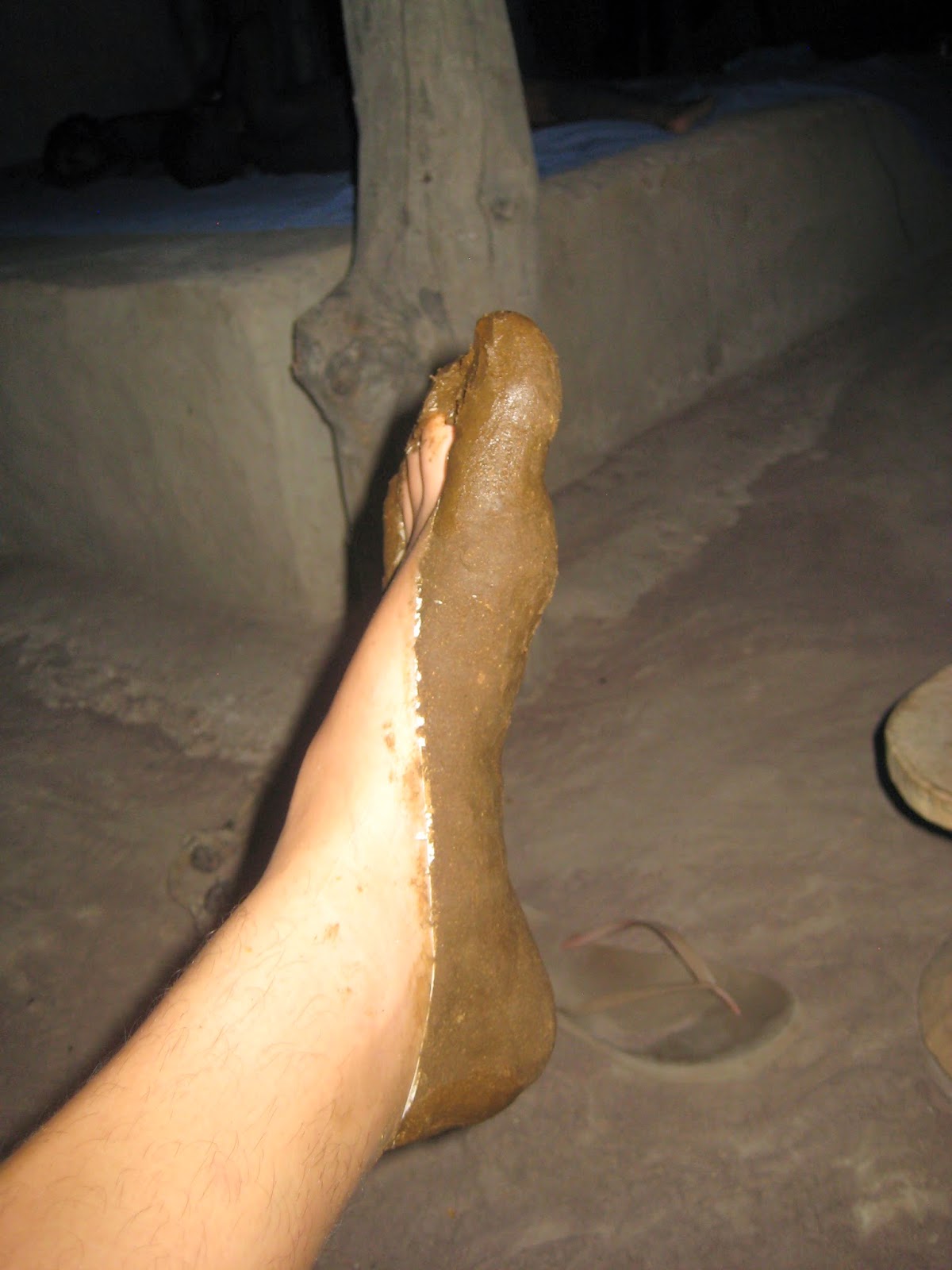
The process here involves covering your feet in designs made out of strips of something resembling medical tape and then covering that with the henna paste. Then, you have to sit for a long time to let that sink in, but for whatever reason this also requires you to cover your feet in plastic bags while you wait?? So since it was nighttime already, I ended up sleeping with plastic bags on my feet for a night haha. The next morning (the day I was told the wedding would start), the bags were taken off and all of the henna paste scraped off. I thought this was the end, but THEN they cover your feet with a mixture of something called “manioc” and charcoal powder, which makes the henna black. You sit with that for another hour or two, and then you’re finally done! It’s supposed to turn completely black, but mine turned a combo of black and yellow, so I just looked like I had bruises all over my feet – eew. But my family, and in fact the entire village, loved it! Everyone noticed and was super excited I had henna on my feet. Though most of it has faded I still get lots of comments and I think it’s because my toenails are black right now so everyone knows I’ve had henna recently…


Look at the beautiful coloration...

The Finished Product!

By about noon no guests had shown up. So I kept asking when the wedding would start and was told “evening”…but around 6pm people just started to arrive, so there must have been some organization or method to the madness! People stayed all evening and we cooked dinner for them in this insanely large pot that the whole village shares for special occasions. Other women in the village came to our compound and were in charge of cooking all of the meals.

That's a lot of rice!
Our chefs
                                     
As the evening progressed, people just sat around and talked, and the young people turned on a radio and started dancing, but no one went home. Then as it got later, it became evidently clear to me that no one was going to leave, but that they were all staying at our house until the next day. So mats got pulled out and people pretty much slept wherever.

The next day, the festivities continued as usual. People sat around and talked, people listened to music, and there was food! At one point all of the young girls gathered my sister’s clothes and went to the well to wash them. Apparently when you get married and move to your husband’s village, you leave all of your old clothes behind and only take new things with you. So we washed her clothes and then left them in the hut.

Carrying my sister's clothes to the well
                                                 

And then it came time for my sister to leave for her husband’s village. I thought there would be some ceremony or event, but the groom didn’t even come to our village for this portion of the wedding. When it was time to leave, a large vehicle pulled up with some of the groom’s friends. The men said lots of prayers and then my sister was loaded into the car with her eyes shielded. They then loaded up all of her belongings, and any of the guests that wanted to go to the groom’s village PILED in (I didn’t go to this part – it was kinda far and my host dad was a bit worried about me attending). From what I understand, the groom’s village is pretty much a replica of what happened in our village: talking, eating, dancing.
My host sister sitting with her head covered while prayers are said
Being carried to the car

People waiting to pile in
So for one day our compound quieted down and then after one day of festivities in the groom’s village, they all came back! The car pulled in again and all of these women, minus my sister, unloaded. They stayed one more night at our house and on the 4th day finally started to return home. Once everyone had left, the silence was heaven. I obviously stuck out through all of this so everyone wanted to talk to me – my Pulaar got a workout which also meant I was extremely tired at the end of every day!

Overall the experience was not quite what I had expected. The event seemed almost sterile to me because no one really paid any attention to the bride. It was a gathering because of her but that didn’t seem to matter. And when it was time to leave for the groom’s village, neither my host mom or host dad went along, nor did they say goodbye to her. Considering that in Senegal, not a lot of travel happens between villages, even a 10K move can mean months before you see each other again, so I found this particularly sad. My village loved my outfit though and people are constantly asking me why I’m not wearing my complet! 
My host mom and me

It was a great adventure in terms of cultural integration!

Thanks for reading! Peace & love, Lindsay